

Why International Businesses Still Use Offshore Companies
- VISS

- May 13
- 3 min read

For decades, offshore companies have been associated with multinational corporations, global investors, shipping groups, and international entrepreneurs. Despite changing regulations and increased scrutiny from governments worldwide, offshore structures remain widely used in legitimate international business operations.
The reason is simple: offshore companies continue to provide practical legal, financial, and operational advantages for businesses operating across borders.
What Is an Offshore Company?
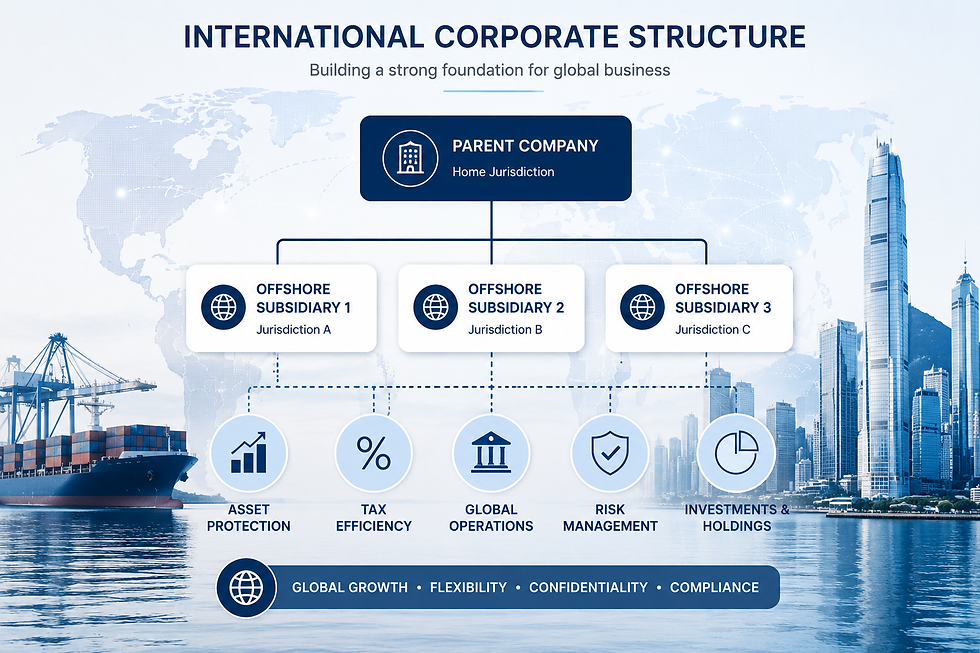
An offshore company is a legal entity incorporated outside the country where its owners primarily reside or conduct business. These companies are commonly formed in jurisdictions known for business-friendly regulations, efficient corporate laws, and international financial services.
Popular offshore jurisdictions include:
British Virgin Islands (BVI)
Panama
Cayman Islands
Hong Kong
Seychelles
United Arab Emirates (UAE)
Contrary to common misconceptions, offshore companies are not inherently illegal or secretive. Many are used openly for international trade, asset management, shipping operations, holding investments, and cross-border transactions.
International Tax Efficiency
One of the main reasons businesses use offshore companies is tax efficiency.
Many offshore jurisdictions offer:
Low or zero corporate tax
No capital gains tax
No withholding tax on dividends
Territorial tax systems
For international companies operating in multiple countries, this can help reduce unnecessary layers of taxation and improve overall financial efficiency.
Importantly, legitimate offshore tax planning must comply with international reporting standards and the tax laws of the business owner’s home country.
Asset Protection
Businesses operating internationally often face legal, political, and economic risks. Offshore companies can help separate ownership structures and provide an additional layer of asset protection.
This is especially important for:
Shipping companies
International investors
Intellectual property holding companies
High-net-worth individuals
Businesses operating in politically unstable regions
Properly structured offshore entities can help protect assets from litigation exposure, creditor claims, or operational risks.
Easier International Operations
Global commerce requires flexibility. Offshore companies are frequently used because they simplify international business activities such as:
Opening multi-currency bank accounts
Holding international contracts
Managing cross-border payments
Owning vessels or aircraft
Facilitating joint ventures
Holding subsidiaries in multiple jurisdictions
Many offshore jurisdictions also offer faster incorporation processes and reduced administrative burdens compared to larger onshore countries.
Privacy and Confidentiality
While global transparency rules have significantly increased in recent years, many businesses still value lawful corporate confidentiality.
Offshore jurisdictions often provide:
Limited public disclosure of shareholders
Enhanced corporate privacy
Confidential business structures
Protection of commercially sensitive information
For legitimate businesses, confidentiality can be important for competitive reasons, investment planning, and personal security.
International Investment Structuring
Private equity firms, investment funds, and multinational groups commonly use offshore holding companies to structure international investments.
Benefits may include:
Centralised ownership
Easier transfer of shares
Investor neutrality
Simplified mergers and acquisitions
Efficient dividend distribution
This is why offshore jurisdictions continue to play a major role in global finance and international capital markets.
The Role of Compliance Today
Modern offshore business is no longer anonymous or unregulated.
International standards such as:
FATCA
CRS (Common Reporting Standard)
Anti-Money Laundering (AML) regulations
Know Your Customer (KYC) requirements
have significantly increased transparency and compliance obligations.
Reputable offshore service providers now work closely with regulators, banks, and legal advisors to ensure clients maintain compliant and properly documented structures.
Offshore Companies in Shipping and Maritime Industries
The maritime sector remains one of the largest users of offshore structures.
Shipping companies often register vessels and corporate entities offshore because of:
Flexible maritime laws
Lower operational costs
International vessel registration systems
Financing advantages
Efficient ship ownership structures
Jurisdictions such as Panama and the Marshall Islands continue to dominate global ship registration for these reasons.
Offshore Does Not Mean Illegal
Public perception sometimes confuses offshore companies with tax evasion or illicit financial activity. In reality, millions of offshore companies are used legally every day by international businesses.
The key difference lies in compliance.
When properly structured and fully disclosed under applicable laws, offshore companies remain a legitimate tool for international business planning, investment management, and global operations.
Final Thoughts
Offshore companies continue to serve an important role in international commerce because they offer flexibility, efficiency, asset protection, and practical solutions for cross-border operations.
As global business becomes increasingly interconnected, offshore structures remain relevant — not as secrecy vehicles, but as strategic tools used within modern legal and regulatory frameworks.
Businesses considering an offshore structure should always seek professional legal, tax, and corporate advice to ensure full compliance with international regulations and local laws.
Need Advice on Offshore Companies?
For more information about offshore companies, international structuring, or maritime corporate services, please contact us at Contact@viss.com.hk.


