Using BVI Companies for International Joint Ventures

BVI companies for international joint ventures can provide a flexible and internationally recognised structure through which two or more parties combine capital, expertise, technology or market access for a specific commercial project.
Rather than one participant operating through the other participant’s existing business, the parties establish a separate British Virgin Islands company to own the joint venture’s assets, enter into contracts, receive investment and distribute returns.
A BVI company does not eliminate the legal, tax or commercial risks of a joint venture. Its effectiveness depends on the company’s constitutional documents, shareholders’ agreement, governance arrangements and the laws of every country in which the parties and the joint venture operate.

What Is a BVI Joint Venture Company?
A BVI joint venture company is normally a company limited by shares incorporated under the BVI Business Companies Act. Its shares are held by the joint venture participants directly or through their respective holding companies.
The BVI company acts as the jointly owned project vehicle. Depending on the transaction, it may:
Own shares in local operating subsidiaries
Hold intellectual property or other project assets
Enter into financing, supply or service agreements
Receive capital contributions from the participants
Coordinate an international investment or commercial project
Act as a regional or global holding company
Hold an asset pending its eventual sale or listing
For example, an Asian manufacturer and a Latin American distributor could establish a BVI company to develop a new regional business. The parties could agree that one participant contributes capital and manufacturing capacity while the other contributes distribution rights, personnel and local market knowledge.
Why Are BVI Companies Used for International Joint Ventures?
The BVI is frequently considered for cross-border joint ventures because its company law offers significant flexibility in relation to share rights, corporate governance and transfers of ownership.
Flexible Share Structures
A BVI company may issue different classes or series of shares with different rights, subject to its memorandum and articles of association.
This allows the parties to create arrangements involving:
Ordinary and preferred shares
Different voting rights
Priority dividend or distribution rights
Rights linked to particular business divisions
Redemption or conversion rights
Special consent rights for particular shareholders
These features can be useful when the participants are not contributing the same amount or type of value to the joint venture.
Customisable Governance
The parties can establish a board that reflects their agreed balance of control. Each shareholder may have the right to appoint one or more directors, while certain decisions can require unanimous approval or a specified shareholder majority.
This gives participants considerable freedom to allocate management authority while protecting important strategic interests.
Neutral Holding Jurisdiction
When joint venture participants are based in different countries, neither party may want the company to be established in the other party’s home jurisdiction.
A BVI company can serve as a neutral corporate vehicle between the participants. This may simplify negotiations over ownership and governance, although the parties must still agree on the governing law and dispute-resolution mechanism for their commercial arrangements.
Familiarity Among International Advisers
BVI companies are commonly used in international corporate structures, investment transactions and asset-holding arrangements. Many lawyers, accountants, financial institutions and professional investors are familiar with the BVI corporate framework.
However, familiarity does not guarantee that a particular bank, investor or commercial counterparty will accept the structure. Acceptance depends on the joint venture’s activities, participants, countries, source of funds and overall risk profile.
Flexible Ownership Transfers and Exit Planning
The company’s memorandum and articles and its shareholders’ agreement can regulate how an investor may transfer or dispose of its shares.
The parties may include:
Rights of first refusal
Pre-emption rights
Tag-along rights
Drag-along rights
Call and put options
Transfers to permitted affiliates
Buyout mechanisms following a deadlock
Procedures for selling the entire business
These mechanisms should be agreed before the venture begins, when the interests of the parties are more closely aligned.
How Is a BVI Joint Venture Usually Structured?
A typical structure may look like this:
Participant | Contribution | Possible rights |
Investor A | Capital and financing | Board appointment, voting rights and preferred return |
Investor B | Technology or intellectual property | Board appointment, licence income and consent rights |
Investor C | Local operations or market access | Profit participation and operational authority |
BVI joint venture company | Holds the joint investment | Enters into contracts and owns subsidiaries or assets |
The BVI company may conduct the relevant business directly. Alternatively, it may act as a holding company above operating subsidiaries in the countries where the business has employees, customers, licences or physical operations.
Whether a holding or operating structure is more appropriate depends on tax, regulatory, substance, banking and commercial considerations.
What Should the Joint Venture Documents Cover?
The two principal corporate documents are usually the company’s memorandum and articles of association and a separate shareholders’ or joint venture agreement.
The memorandum and articles govern the company as a matter of BVI corporate law. The shareholders’ agreement records the commercial arrangements between the participants. These documents should be prepared together so that their provisions do not conflict.
Ownership and Contributions
The documents should identify:
Each party’s initial shareholding
Cash and non-cash contributions
The valuation of intellectual property, assets or services
The timing and conditions of each contribution
Consequences if a party fails to contribute
Whether future funding will be provided as equity or shareholder loans
Promises to provide expertise, customers or commercial opportunities should be described precisely. Vague obligations are difficult to measure and enforce.
Board Composition and Management
The agreement should specify:
The number of directors
Each shareholder’s appointment rights
The chairperson’s role and voting powers
Quorum requirements
The frequency of meetings
Delegated authority for executives
Banking and signing authority
Reporting and information rights
The structure should allow the business to operate efficiently without permitting one party to make fundamental decisions unilaterally.
Reserved Matters
Reserved matters are decisions that require a higher level of approval than ordinary business decisions.
Common reserved matters include:
Issuing new shares
Changing the company’s business
Approving major borrowing
Acquiring or disposing of significant assets
Entering into related-party transactions
Approving or changing the annual budget
Paying dividends
Appointing senior executives
Creating security over company assets
Commencing litigation
Selling or winding up the business
The approval threshold should protect minority participants without making routine management impractical.
Profit Distribution
The parties should agree whether profits will be reinvested or distributed. A dividend policy may take account of working-capital requirements, financing obligations, regulatory restrictions and future expansion plans.
Economic returns do not necessarily have to correspond exactly to voting power if the relevant share rights and contractual arrangements are properly established.
Intellectual Property
If a participant contributes technology, trademarks, software or confidential know-how, the documents should clarify:
Whether ownership is transferred or licensed
The territory and duration of any licence
Who may develop improvements
Who owns newly created intellectual property
What happens to the rights when the joint venture ends
Which confidentiality and data-security obligations apply
Intellectual property provisions are especially important for technology, manufacturing, licensing and research ventures.
Restrictions and Conflicts of Interest
The agreement may address confidentiality, non-solicitation, competing businesses and the use of corporate opportunities.
Any non-compete provisions should be reviewed in the jurisdictions where they are intended to operate, as enforceability differs between countries.
Deadlock Procedures
A 50:50 joint venture can become unable to act if the participants disagree. The agreement should therefore establish a clear escalation process.
Possible deadlock mechanisms include:
Referral to senior representatives
Mediation or another structured negotiation process
Independent expert determination for technical questions
A buy-sell mechanism
A sale of the company or its assets
Winding up as a last resort
Not every mechanism is appropriate for every venture. A forced buyout arrangement, for example, may disadvantage a participant with less access to financing.
Default and Exit
The parties should define what happens following insolvency, material breach, sanctions exposure, loss of a required licence, change of control or failure to provide agreed funding.
The exit provisions should also cover valuation procedures, payment terms, warranties and the treatment of guarantees, loans and intellectual property.
BVI Joint Venture Compliance Requirements
A BVI joint venture company must maintain its registered agent and registered office in the BVI and pay the applicable annual government fees.
Depending on its circumstances, it must also address the following requirements.
Corporate Registers and Beneficial Ownership
BVI companies are required to maintain and file prescribed corporate information. Under the regime effective from 2 January 2025, BVI companies are generally required to file beneficial ownership information with the Registry of Corporate Affairs through the VIRRGIN system, subject to the applicable legislation and exemptions. Access to this information is legally restricted; it should not be assumed that beneficial ownership is completely anonymous. BVI Financial Services Commission
The registered agent will require identification, ownership, source-of-funds and business information from the participants and ultimate beneficial owners.
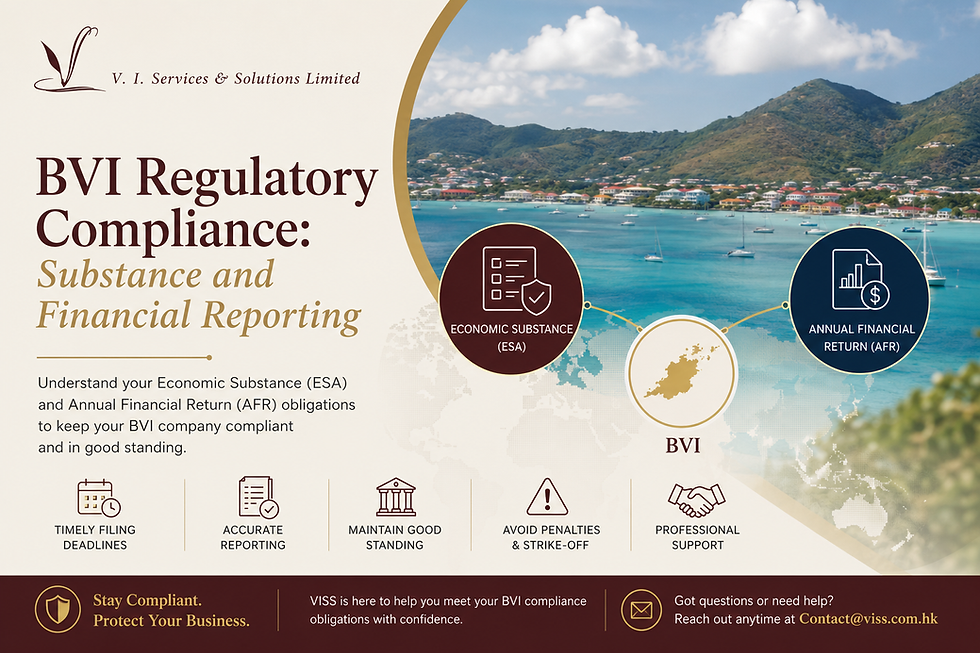
Accounting Records and Annual Financial Return
A BVI company must maintain sufficient accounting records to explain its transactions and financial position.
Unless an exemption applies, it must file an annual financial return with its registered agent. The return contains a simplified balance sheet or statement of financial position and an income statement. It is generally due within nine months after the end of the company’s financial year. BVI Business Companies (Financial Return) Order, 2023
This filing is not necessarily the same as preparing audited financial statements. Audit requirements may nevertheless arise under contractual arrangements, financing documents, sector-specific regulations or the laws of another jurisdiction.
Economic Substance
The company must determine whether it carries on any activity falling within the scope of the BVI economic substance legislation.
Relevant activities can include holding business, headquarters business, financing and leasing, shipping, banking, insurance, fund management, intellectual property business and distribution and service centre business.
The appropriate treatment depends on the company’s actual activities, income and structure. A company that merely describes itself as a holding company should not assume automatically that no substance obligations apply. BVI International Tax Authority economic substance rules
Tax and International Reporting
A BVI company should not be viewed as a substitute for international tax planning.
Before establishing the joint venture, the parties should consider:
Where the company will be tax resident
Where its directors make strategic decisions
Whether it creates a permanent establishment
Controlled foreign company rules
Withholding taxes on cross-border payments
Transfer-pricing requirements
Taxation of dividends and capital gains
Indirect taxes and customs duties
FATCA and Common Reporting Standard obligations
The tax treatment of intellectual property and shareholder loans
The BVI’s domestic tax position does not prevent another country from taxing the company, its income or its shareholders.
Licences and Regulated Activities
Incorporating a BVI company does not authorise it to conduct a regulated business.
Financial services, investment activities, virtual asset services, insurance and other regulated activities may require a BVI licence. The joint venture may also require licences in every country where it operates or offers its products and services.
Banking for a BVI Joint Venture Company
A BVI company may apply for an account with a traditional bank or payment institution, but approval is never automatic.
Institutions will normally assess:
The identities and backgrounds of all participants
The commercial purpose of the joint venture
Source of wealth and source of funds
Expected transactions and currencies
Customer and supplier countries
The company’s contracts and business plan
Physical operations and economic substance
Tax residence and reporting status
The ownership and decision-making structure
A clear joint venture agreement, realistic financial projections and evidence supporting each participant’s contribution can strengthen the application.
The parties should investigate banking feasibility before finalising the structure, particularly when the business involves higher-risk activities or jurisdictions.
When Is a BVI Company Suitable for a Joint Venture?
A BVI company may be suitable when:
The participants are located in different countries
The parties want a neutral holding vehicle
Flexible voting and economic rights are required
The venture will own subsidiaries or international assets
Investors require defined transfer and exit rights
The ownership structure may change over time
It may be less suitable when the business requires substantial operations in a particular country, a local regulator expects a domestic entity, tax-treaty access is essential, or the proposed bank will not accept the structure.
The correct jurisdiction should be selected only after comparing the legal, tax, regulatory, operational and banking consequences.
Frequently Asked Questions About BVI Joint Ventures
Can a BVI company have two equal shareholders?
Yes. A BVI company can be owned equally by two shareholders. However, a 50:50 structure should include carefully designed deadlock and exit provisions.
Can different shareholders have different voting or dividend rights?
Yes. Different classes or series of shares can be created with different rights if those rights are properly reflected in the company’s memorandum and articles.
Does a BVI joint venture need a shareholders’ agreement?
A shareholders’ agreement is not always legally mandatory, but it is strongly recommended for a joint venture. It defines the participants’ commercial rights, obligations, governance arrangements and exit procedures.
Can a BVI company own operating subsidiaries?
Yes. A BVI company may hold shares in subsidiaries incorporated in other jurisdictions, subject to the laws and regulatory requirements applicable to the group.
Is the ownership of a BVI company anonymous?
No structure should be promoted as anonymous. BVI companies are subject to beneficial ownership identification and filing requirements. Access to filed information is governed and restricted by law, but the company and its registered agent must collect and maintain accurate ownership information.
Must a BVI joint venture prepare financial records?
Yes. BVI companies must maintain adequate accounting records. Unless exempt, a company must also submit an annual financial return to its registered agent within the prescribed period.
Does a BVI company automatically avoid tax?
No. Tax consequences depend on where the company is managed, where it operates, the residence of its shareholders and the nature of its transactions. Advice should be obtained in every relevant jurisdiction.
Can a BVI company open an international bank account?
It can apply, but approval depends on the financial institution’s KYC, AML and commercial acceptance criteria. Incorporation does not guarantee account approval.
Establishing a BVI Company for an International Joint Venture
A successful joint venture requires more than incorporating a company. The structure should integrate the parties’ commercial agreement with appropriate corporate governance, compliance, banking and tax planning.
Before proceeding, the participants should define:
The venture’s business and geographic scope
Each party’s contributions
Ownership and economic rights
Board and management authority
Future funding obligations
Reserved matters
Deadlock procedures
Transfer and exit rights
Intellectual property arrangements
Tax, substance and regulatory responsibilities
V. I. Services & Solutions Limited can coordinate the incorporation and ongoing administration of a BVI joint venture company and work with the parties’ legal and tax advisers to implement the agreed structure.
For assistance with a BVI company for an international joint venture, contact our team at Contact@viss.com.hk or visit www.viss.com.hk.
This article provides general information and does not constitute legal, tax or investment advice. Professional advice should be obtained for the circumstances of each transaction.